The pulse of Eurorack: voltage
The pulse of Eurorack: voltage
Sound is a mechanical pressure wave. To reproduce a sound either electronically or digitally we need to make systems that mimic the nature of real life things. The speaker is the primary interface between the sound and the listener. The speaker has to behave like a resonant body moving stuff around it in a periodic motion - generate pressure waves for our ears to pick up on and convert that piece of information to an auditory experience. That stuff is just the air particles around it. So how does speaker make these movements? We use voltage to mimic the behaviour of a resonant body vibrating at a resonant frequency. Why voltage?
Voltage in electronics
Voltage in electronics is associated with two different behaviours: first, in Alternating Current (AC) the voltage has polarity and can alternate between two values; second, in Direct Current (DC) the polarity is fixed. In DC, voltage stays on one side of the reference point. It can rise and fall but never crosses to the other side. The polarity lets us do some extra work that DC cannot do: move a speaker.
AC: voltage crosses the reference
DC: voltage stays on one side
So, let's make a device with a coil sitting in a magnetic field and pass AC voltage. Then I use this device to move a diaphragm which is a sheet suspended at its edges. When the voltage polarity in the coil goes "positive" the coil pushes outward and when the polarity goes "negative" the coil moves inward. This sheet moves the air around generating the pressure waves which then our ears pick up and send this information to the brain which interprets the information as sound. The diaphragm in our ears does something similar: converts the pressure wave into a mechanical wave. The output in both cases is mechanical motion but from different sources.
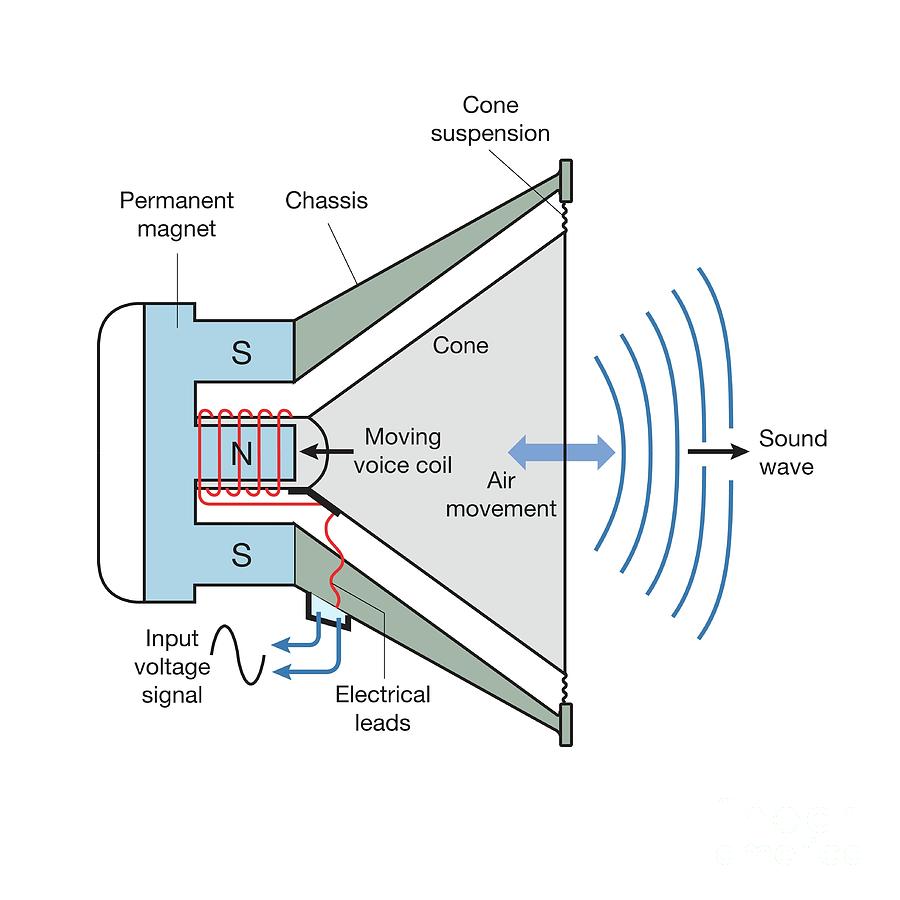
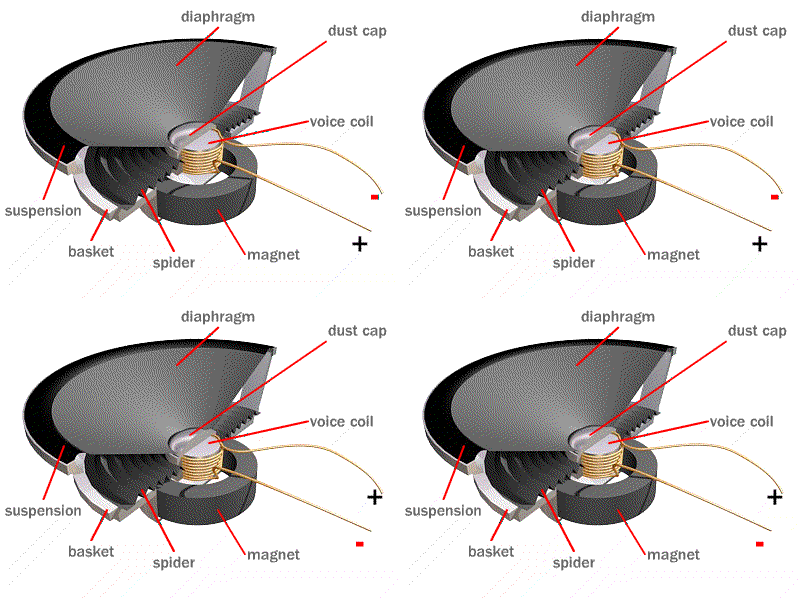
To generate these pressure waves electronically, we also use AC voltage. When something vibrates between 20 and 20,000 times per second, we perceive those vibrations as pitch (the upper limit varies from person to person). To drive a speaker, we need to feed its coil an AC voltage. So let's build a device that generates one. The key component is a capacitor — it stores charge and voltage develops as a consequence. The voltage across it is proportional to that stored charge. By pushing current in and pulling it back out, we make the capacitor's voltage swing up and down, and that swinging voltage is the AC we send to the speaker's coil. To generate a 100Hz tone, we push current into the capacitor so its voltage rises. As soon as it reaches an upper threshold, we discharge it back through the reference point and into negative territory, then bring it back up completing one full cycle. The component that watches the capacitor and decides when to flip is called a comparator: it continuously compares the capacitor's voltage to the threshold and triggers the reversal at the right moment. The shape of the resulting waveform — how the capacitor rises and falls between the thresholds — determines the timbre. In Eurorack, audio signals typically swing between +5V and -5V around a reference point of 0V. To generate 100Hz, the voltage completes one full cycle up to +5V, down through 0V to -5V, and back to 0V 100 times per second. And just like that, we have a source of voltage oscillations at a particular frequency.
So now I have a sound source playing one pitch at 100Hz. Now what if I want to add vibrato to the sound? Vibrato is a small regular wobble in pitch like a singer holding a note and letting it shimmer. The pitch doesn't really leave the central note; it just oscillates around it, a few times per second. To do this electronically, I need a way to gently push the oscillator's pitch up and down, repeatedly, in time. Remember: the pitch of our oscillator is set by how fast the capacitor charges. So if I can make that charging rate wobble speed up slightly, slow down slightly, speed up again the pitch will wobble too. What I need is another voltage that varies over time, slow enough that I can hear individual wobbles. About 5Hz works well for musical vibrato. I feed that slow voltage into the oscillator, and the oscillator's pitch follows it up and down. The voltage rises and the pitch rises slightly; the voltage falls and the pitch falls slightly. Vibrato. Any voltage that varies over time can be used to modulate a property of sound.
Or instead of wobbling the pitch, what if I want to change it like this: play a 100Hz root, then jump up to a 125Hz which is a major third musical interval of 100Hz as the root note? That's a different musical idea, but mechanically it's the same trick: I need a voltage that controls the oscillator's pitch, and now I need that voltage to hold one value for a while, then jump to another. A bit of music theory first. In Western music, a major third is a consonant interval where the upper note vibrates 5 times for every 4 vibrations of the lower note — a 5:4 ratio, or 1.25x the root frequency. (Modern keyboards use a slightly squashed version called equal temperament, where the major third comes out to about 1.26x close enough that the difference is mostly inaudible.) So 100Hz x 1.25 = 125Hz. Same interval, an octave up: 200Hz x 1.25 = 250Hz. The ratio is what defines the interval, not the absolute Hz difference. In Eurorack the standard is 1V/octave: every additional volt of control voltage doubles the oscillator's frequency. +1V = up an octave. +2V = up two octaves (4x the frequency). -1V = down an octave. A control voltage (CV) is a DC voltage that controls a parameter of a sound source for eg. the pitch of an oscillator. A major third is the 4 semitones above the root of 12 equal tempered tones per octave, so it corresponds to roughly +0.333V. To play 100Hz then jump up to 125Hz, I need a control DC voltage that holds at say, +1.000V for a while then jumps to +1.333V.
Now notice something important about this voltage. It rises, it falls, it jumps between values but it stays on one side of zero. It doesn't alternate polarity the way an audio signal does. A 100Hz sine wave coming out of the oscillator swings between +5V and -5V around 0V that's AC. But this control voltage holds at +1.000V, then jumps to +1.333V; the value itself is the information. This is DC.
That's what Eurorack systems do, they use AC voltage to produce sound and use DC voltage to shape the sound in some way. Let's say I have a song with 120BPM so that's 2 beats every second. If I play a note at 100Hz with a voltage going ±1V to generate that pitch for the first 2 beats and then hold the voltage going ±1.3V for the next two beats what I have done is created a small melody. A melody with 2 notes but still a melody.
Ok, so what have done so far? We have used AC voltage to generate sound and DC voltage to shape that sound and make it musical. In fact shaping the sound in anyway be it pitch or volume we use a DC control voltage to achieve the desired effect. Interesting right? Makes sense that why voltage is used in electronic circuits but this doesn't tell us why voltage? OR
What the hell is voltage?
The physics of voltage
We are quite familiar with magnets. If you have two magnets and if you bring the north pole of one of the magnets close to the south pole of the other one they attract each other and bring them close enough they stick to each other. Or, put a bar of magnet under a piece of paper and sprinkle iron fillings on the paper and all the iron fillings line up in a pattern showing the field of the magnet. Take a compass and it will align with the magnetic field of the earth. That's magnetism.
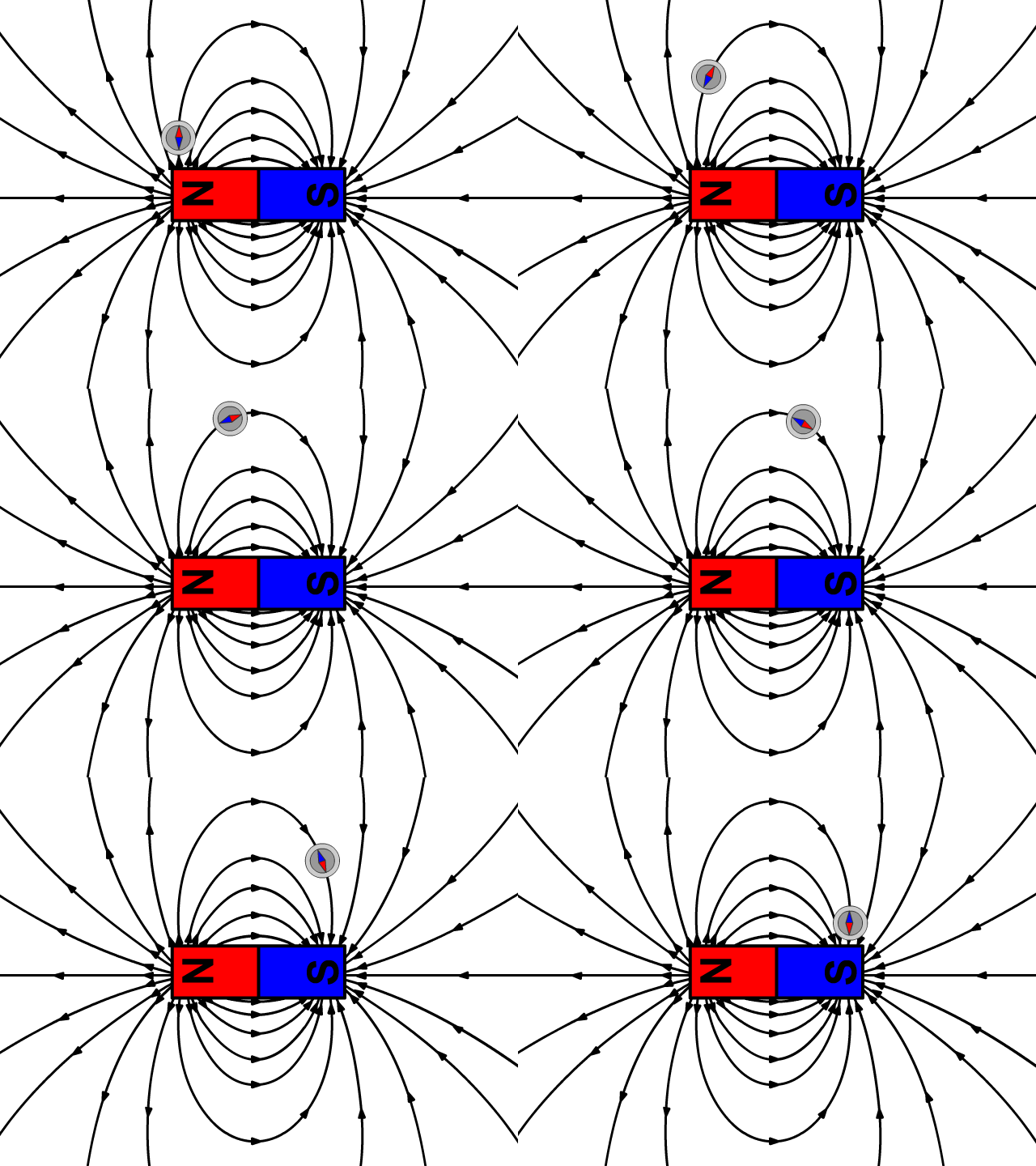
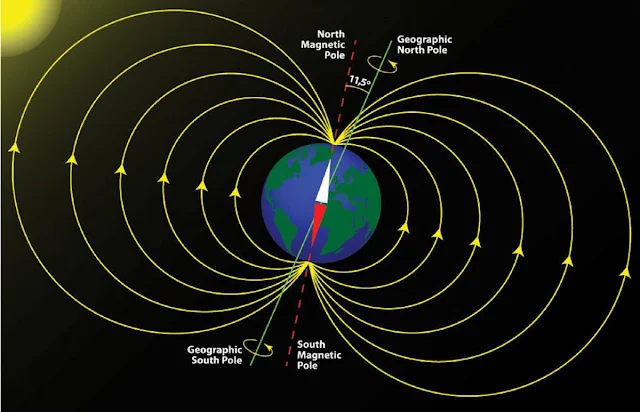
There's another type of invisible field besides magnetism which is called the electric field or electrostatic field. This field is invisible, and can attract or repel objects. However, it is not magnetism. It is voltage.
Let's backup a little and let's understand what these things are. Our physical reality is governed by four main forces that have been discovered so far: gravity, electromagnetism, the strong nuclear force, and the weak nuclear force. Each force operates through specific quantum fields that mediate the interactions between matter particles. We'll get to those fields later, but for now, think of the forces as the four basic categories of how things can affect each other. But what is a force? If you push or pull an object, you're applying force to it. Force is what changes motion of things. Force is an inferred quantity, it cannot be directly measured. An object's motion only changes when another object is present and acting on it. The action is defined as force. The only way to quantify it is the how strong the motion is applied for by the force. A static force keeps things held in place against another force whereas a dynamic force accelerates things. Aristotle thought force was needed to keep things moving and that they eventually come to rest naturally. However, Galileo in the late 16th and early 17th century theorised that if we were to completely remove friction an object in motion would continue to move indefinitely. Newton refined this theory and provided his 3 laws of motion. His second law says:
F = ma
Force is mass times acceleration. However, this doesn't tell you what force is, instead it tells you the relationship between force, mass, and acceleration. Remember, force can only be quantified through experimentation. Push a book kept on a table. What's pushing the book? Your hand. But the physical interaction is happening between particles. The sensation we feel is the result of that interaction between the atoms of your hand and the book. This repulsive force is one of the four fundamental forces acting through a field. Think of a field as a region of space surrounding a particle, where the particle's influence reaches out and can act on other particles. The field is the medium through which one particle's existence affects another's.
Now you might ask, what is field? This is where things get interesting. To understand field we need to dabble into Quantum Field Theory (QFT). In the classical Newtonian physics we understand our reality through particles. Think of molecules, atoms, electrons, protons, and neutrons. But quantum field theory says our reality is made up of fields and not particles. Particles are just quantised excitations of fields. Remember, light behaves as both particle and wave. So why this duality? QFT says that's because the fundamental "element" is field in space and not particles in space. This still does not answer what exactly is a field. Let me give you an analogy.
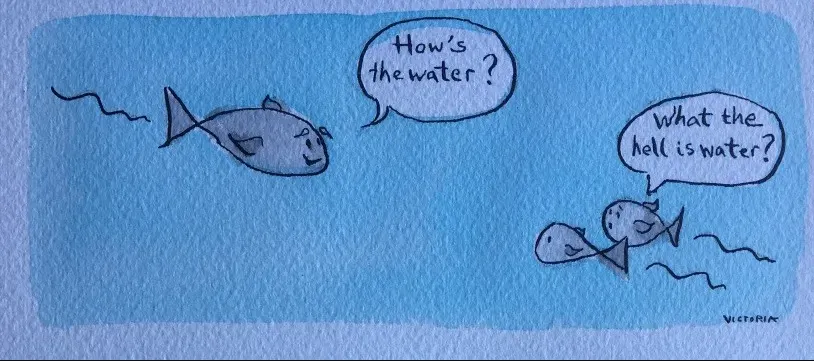
Modern physics tells us that the fabric of the universe is space time. All electrons in the universe have the same mass, the same charge. The electron in a banana is identical to one shot out of the sun. How is this possible? These particles behave as if they are a local manifestation of a single object which fills the whole universe. This single object manifesting itself in different localised elements is the field. The fish living under the water don't really know that they are surrounded by this fluid called water. Similarly, we are surrounded by this fluid called a field. Field is a function of spacetime. In physics, a field is like a fluid which fills all the spacetime and at each point in this field there's a physical quantity a number, or a direction, or both that we describe mathematically. The field can contain vectors (direction) or scalars (numbers) as objects. In a way a field is a mathematical idea. In abstract sense you assign a a value to every point in space and these points can be described with a scalar or vector. You can also think of field as a function (functions in programming). They take an input and give you an output. The input to field is a point in space and time and the output could be a number (scalar), vector, or some other mathematical object. The field is a mathematical abstraction, we are using math to describe our physical reality. The field is a pure mathematical concept but it does describe real behaviour.
Think of the weather forecast on TV showing a map of the wind where they draw arrows at different points on the map to show how the wind is blowing. That's a vector field as it assigns a vector which has magnitude and direction to every point on the map. Now think if the temperature map where they show how hot is are different points on the map. This is a scalar field as it associates every point with a number and that being the temperature. So, field is some map (or function) that takes some coordinates and gives us some other things like scalars, vectors, tensors, etc.
We live in an analog world, on a macroscopic level most things are continuous. That is until we start looking at the microscopic level. At the field level elements exist in discrete quantised states. Quantum comes from Latin quantus meaning "how much, as much as so much as". Light comes in discrete chunks called photons. It is a discrete quantised excitation of the electromagnetic field. The photon is one quantised excitation of the field. The field itself is continuous, it has values at every point in space. What's discrete is the energy you can put into a field. The minimum energy is one quantum i.e. particle and you can add energy in multiples of that quantum. You cannot have half, 3/4th, etc. of excitation. There are around 17-37 fields depending on how you count and electromagnetic (EM) is one of them. In fact, EM is also a force that exists in that field. A photon does not have mass and hence it can travel at the speed of light. Any massless particle is forced to travel at c; photons travel at c because they're massless.
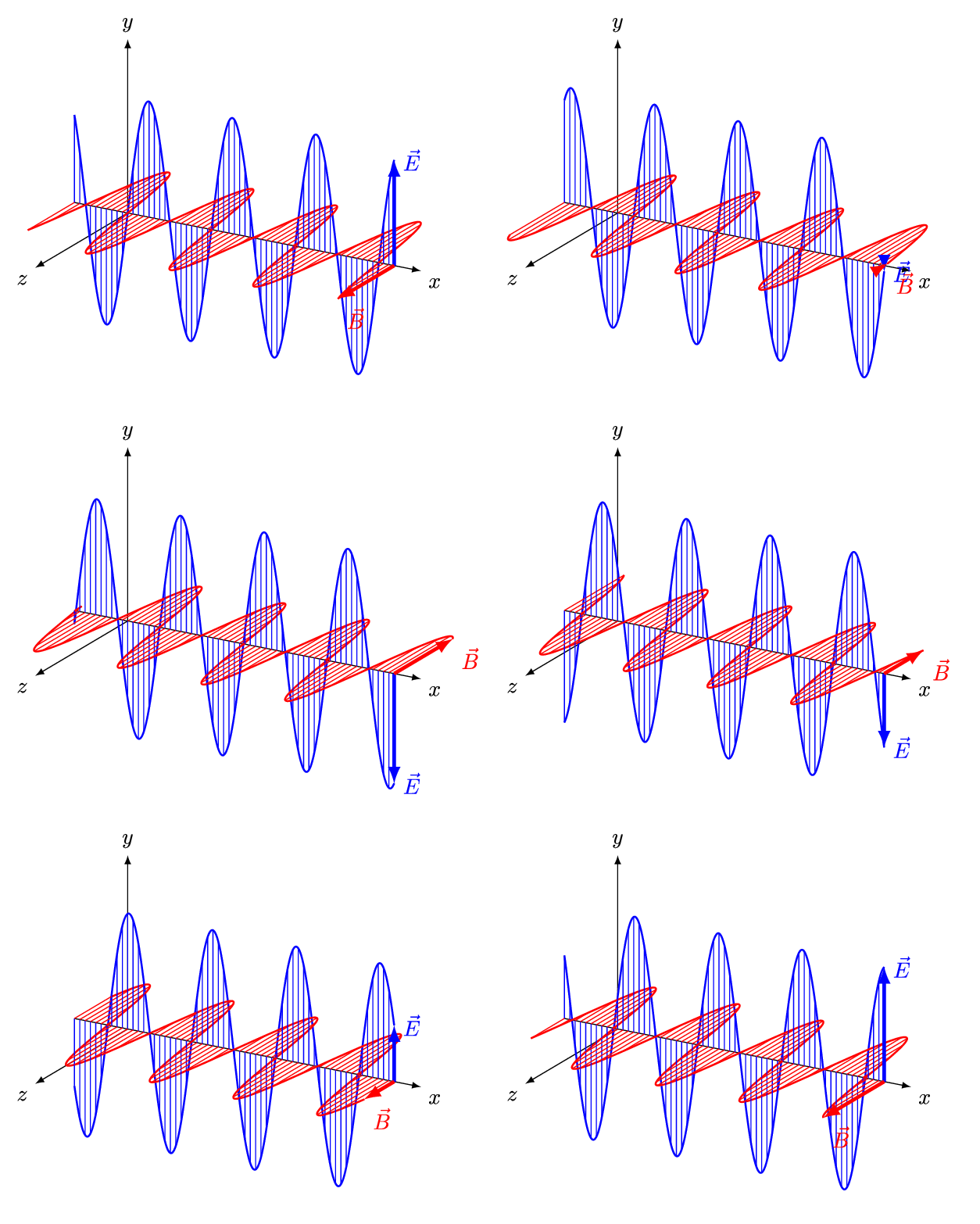
So we have fields which exert force in the field. Any fundamental interaction is mediated by one or more force carrying fields. Like photons, the electron is a quantum of another field called the electron field. This field is categories as matter field as it has mass. An electron is simply an energy increment of a spread out electron field.
Ok, so we have fields which give rise to particles and these particles have certain properties because of the fields from which they arise. One of such properties of a particle is charge. Not all particles have charge though. For example a neutron is neutral: no charge. Charge again is one of those properties that just exist and we can't really explain why is it an inherent property of some particles. You ask what is charge fundamentally, but that can't really be answered since charge itself is fundamental. But let's still try to understand what exactly is a charge in an abstract sense. Charge is a kind of tag or label we assign to particles that tells us how they interact with electromagnetic fields. We know from experiments that is exists but not sure why and it charge follows some very specific rules. One of them is based on what is known as symmetry. Imagine rotating a circle, - it still looks the same no matter how you turn it. Physics looks for similar kinds of symmetries in how the laws of nature work. Charge comes from a symmetry called U(1).Here's the idea: in quantum mechanics, every charged particle has an internal angle associated with it — think of it like the phase of an oscillator, an angle that runs around a circle. Nothing observable about the particle depends on what that angle is in absolute terms; only differences between phases matter. So if you took every charged particle in the universe and shifted its phase by the same amount, nothing physical would change. That invariance is the U(1) symmetry. Another theorem called Noether's Theorem states that every symmetry comes with a conserved quantity - something that doesn't change over time. In this case, we call this conserved quantity an "electric charge" which means charge can move around but it can't just appear or disappear, it is always conserved. Imagine a tub of water. It looks smooth and continuous to us from our point of reference. This water has flow, pressure, and density — quantities we deal with at a macroscopic level. But zoom in far enough and that picture changes: water is made of molecules that behave completely differently from what they collectively form. Another idea in physics, renormalisation, tells us we don't need to know the microscopic physics to describe the macroscopic behaviour we figure out which features survive at the scale we care about. This is why we can talk about voltage, current, and charge in everyday terms without invoking quantum fields every time, even though those fields are what underlies it all. The U(1) symmetry that produces charge, though, isn't a macroscopic averaging it's exact at every scale we can probe, which is part of why electric charge is so precisely conserved.
Physicists in the late 1700s and early 1800s were trying to figure out exactly what electricity is. All we know is that this property interacts with electric and magnetic fields. They discovered that some objects could be "charged up" as well as "discharged". So they used the word "charge" as the single unit of electricity. Charge is a property that determines how strongly a particle couples to the electromagnetic field. Particles with non-zero charge interact electromagnetically while particles with zero charge don't. An electron has charge of -1 elementary unit so it feels the EM force. A photon has zero charge so barely feels the EM force. A proton has charge of +1 elementary unit so it feels the EM force. Unlike mass which is always positive, charge can be positive or negative. Electrons are negative; protons are positive. To charges of the same sign repel each other; two charges of the opposite signs attract. The fact there are two kinds of charges and they cancel each other is why EM force despite being 1036 to 1042 times stronger than gravitational force, EM force cancels out at large scales while gravity does not. Gravitational force unlike electromagnetism, has only one "sign" - all masses attract each other.
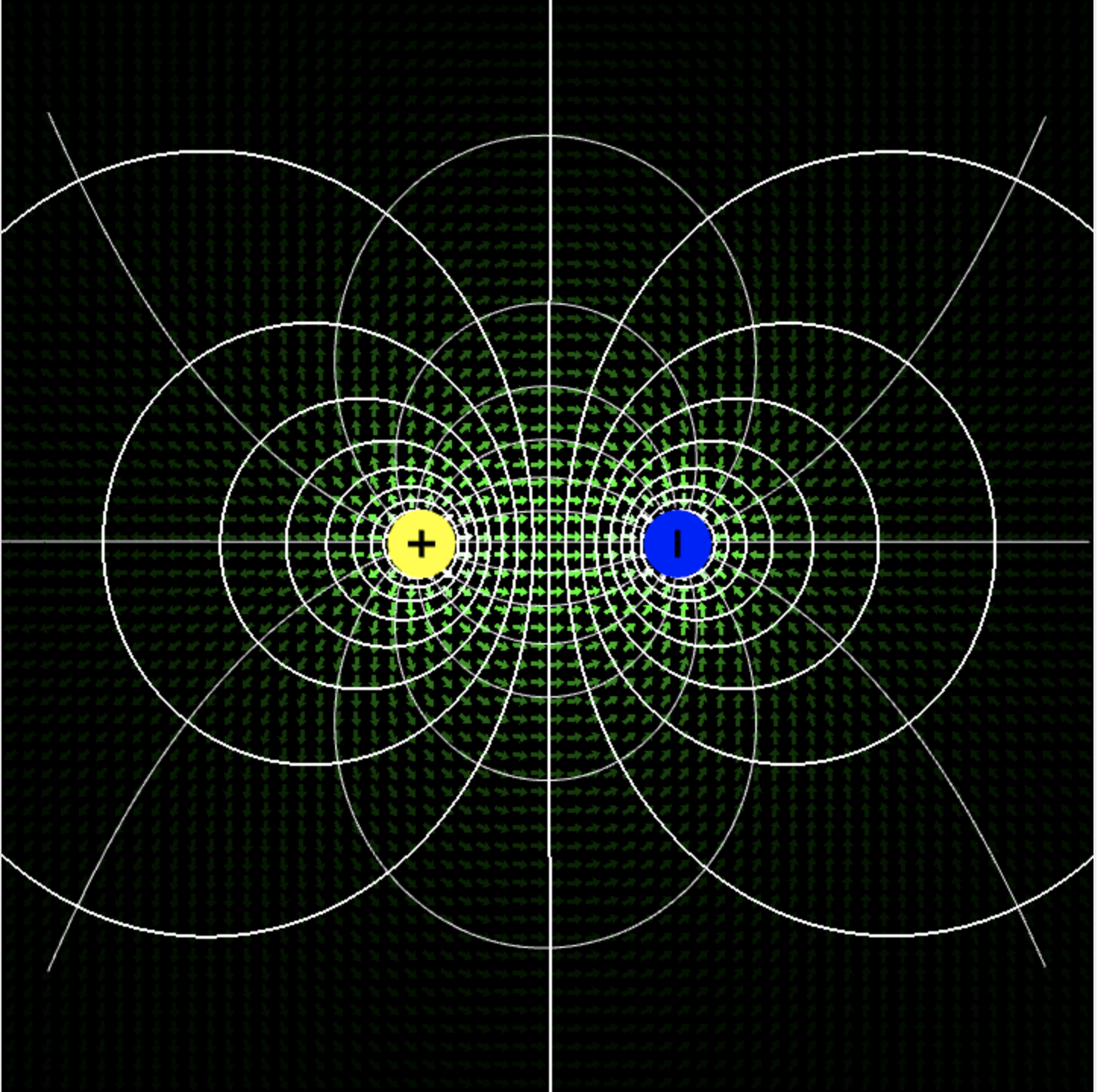
Another property of charges is that they create an electric field around them. Use the simulator below and place either the proton (+1 nC) or the electron (-1 nC) in the box.
Once you place a charge you'll be able to see the field lines. If you drop a proton in the box you'll see field lines going outwards from the charge and if you drop an electron you'll see the field lines going inwards. This is a standard convention where the direction of the electric field is defined as the direction a positive charge will be accelerated. So if you were to place another positive charge near a proton, that charge will be repelled away and hence the field lines go outwards. Remember, field just a numerical value assigned to every point in space. In the electrical field that assigned numerical value is the voltage. Voltage is a way of using numbers to describe an electric field. Electric fields are measured in volts over a distance. There is another way to intuitively understand voltage and that is to understand how height relates to gravity.
Voltage: the potential to do work
Does a rock at the top of the hill have height? Well yes sure it's at the top of the hill but more precisely the position of the rock is high. The height belongs to the location, not the rock. Move the rock somewhere else and its height changes not because the rock has changed but because its location has changed. Different rock same spot and you get the same height. Height is the property of where you are in the space, not of what's there. Same with voltage. Gravity force is an attractive force. It never repels unlike electromagnetic force. This attractive property of the gravitational force can be used to do work. Dams are a good example of this. Most hydroelectric power comes from the potential energy of damned water driving a turbine and a generator.
So let's say hypothetically you want to use a boulder going down the hill for doing some work. Let's roll the boulder on a hill and by rolling it up at a particular height what you have done is stored potential energy into the boulder by the virtue of its height. Remember, the boulder itself does not store that potential energy, it merely has access to that because of its height. Once you let it go down the hill the potential energy is converted into kinetic energy, but the hill is still there. The height of the hill has potential energy not that the hill is made of potential energy.
Coming back to voltage, electric field and voltage are basically the same thing. If e-field is like the slope of a hill then the volts are like the various heights of each different spot on the mountain. Voltage and e-fields are two ways to describe the same basic concept. Voltage is a bit like altitude; it is a measurement made between two things. Question: what's my distance? This sounds bizarre because I didn't ask my distance from what. My altitude is let's say 300m above sea level but simultaneously is 2m from the floor and 150 million kilometers from the sun. If you start at the negative end of a battery and call that end zero volts and so the other end, the positive one must be 9V (for a 9V battery). What if you start at the positive end instead? Then the positive terminal is zero volts and the negative terminal is negative 9V. What if you start half way between the two terminals? The one terminal has +4.5V and the other has -4.5V. This begs the question: what is the real voltage of the positive terminal only? We don't know, the terminal can have several voltages and the same time. We can easily imagine the distance between two points and we can imagine the voltage between two points. Single objects don't have altitude and single objects don't have voltage.
In the word "electromagnetism" the term electro does not refer to electricity, it actually refers to voltage! Electromagnetism has two sides: magnetism and voltage. Voltage isn't the only thing on the electric side; it's the most accessible measurement of it. Pick up some nails with a magnet and that's an example of magnetism. Now pick up some bits of paper with a plastic comb rubbed with wool and that's an example of what voltage represents: separated charge exerting force across space.
Voltage is associated with electrical energy and so is magnetism. In mechanical physics both the kinetic energy and potential energy are part of matter. The relative motion of an objects stores kinetic energy while potential energy is stored in stretched or compressed objects. In a similar way, electrical kinetic energy appears whenever charges flow. The flow of charges is called electric current and it causes magnetism. Electrical potential appears whenever positive charges are taken away to a distance from their corresponding negative charge. This is called "net electrostatic charge" and it causes voltage. Electrical KE is associated with current and electrical PE is associated with voltage. However, there is a small caveat to this point. Calling voltage as a type of potential energy is not fully accurate. Voltage can exist in space by itself with no charges. Remember in the hill analogy: once the boulder has rolled down the hill, the hill is still there. The hill is like voltage, the height of the hill has "gravitational potential" but the hill is not made of "potential energy" since we need both the hill and the boulder to create potential energy. PE belongs to the system (boulder + Earth's gravitational field), not to the hill alone or the boulder alone. Similarly, with voltage if we want to store any electrical potential energy we need some charges but we also need some space filling voltage fields through which we can push our charges. The charges are like the boulder while the voltage is the like the hill. You can push an electron up a voltage hill and if you let it go it will roll down the hill; take away that electron and the voltage-hill is still there.
Now let's synthesize all of the information provided above and see what exactly is voltage doing when I turn on my oscillator. Oscillator works by charging and discharging a capacitor. Think of capacitor like a battery which can hold some charge (A battery stores voltage, but a capacitor stores charge). By pushing current in and pulling it back out, we make the capacitor's voltage swing up and down, and that swinging voltage is the AC we send to the speaker's coil. We define current moving from positive to negative terminals on a battery but physically the positive end is the absence of electrons and the negative end is the surplus of electrons. Electrons drift through the circuit from battery's negative terminal to its positive terminal. Think of tube full of marbles. If you push the marbles at one end of the tube marbles come out of the other end. However, the marble coming out of the tube is not the same marble as the one being inserted. This is how electrons work in a wire. They don't travel in the circuit, they just drift and this drift leads to electric current. But how are these electrons moving? They are moving because of voltage! In the early days of electricity, voltage was called Electromotive force and you'll sometimes see E being used to denote voltage in a mathematical equation. An oscillator does not use the AC voltage coming directly from the wall socket. The socket provides AC at roughly ±325V peak, oscillating at 50Hz. The voltage of the socket varies in different parts of the world. North America, parts of Japan, etc. peak around ±170V at 60Hz. An oscillator cannot work with this it's too high, and it's AC, not DC. What actually happens is the AC from the socket passes through a power supply, which uses a transformer to step the voltage down, diodes to convert AC to DC, and capacitors to smooth out the ripple. The output is steady ±12V DC. This DC rail acts as the reservoir of potential energy for the oscillator. A transistor based current source meters out a controlled trickle of current from this rail onto the timing capacitor's plate, charging it linearly over time. The charging and discharging of the capacitor forms the alternating pattern of oscillations that we associate with sound. The voltage of the capacitor drives current in the speaker's coil which in turn moves the diaphragm which pushes the air around it creating a mechanical wave in the atmosphere which we perceive as sound.